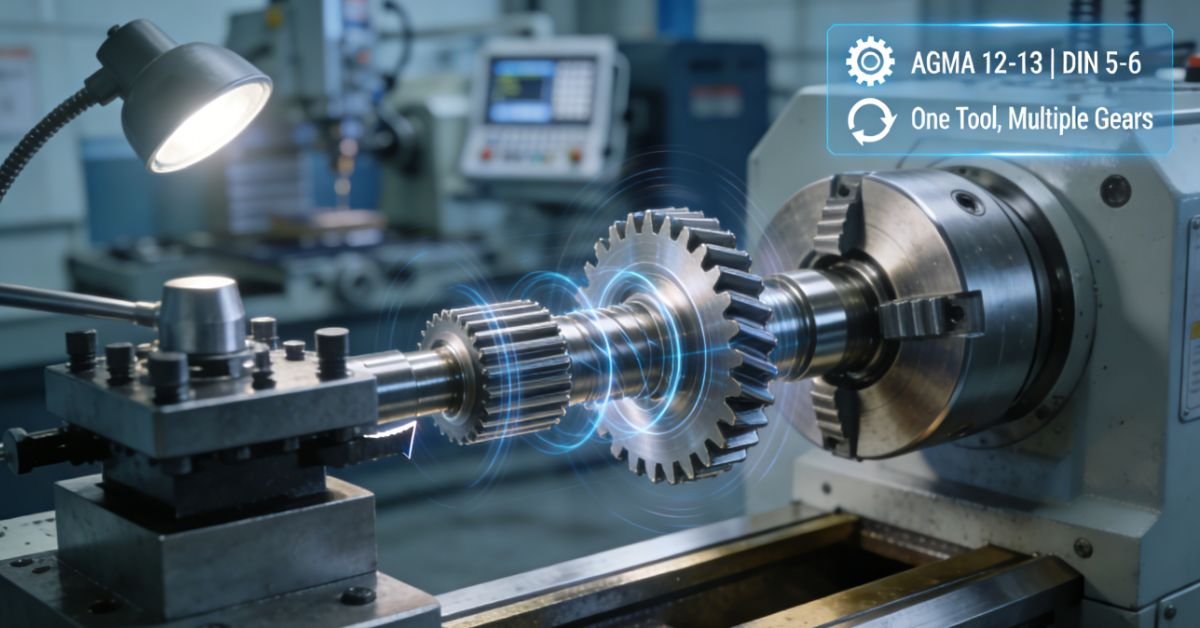
How to improve gear manufacturing accuracy to AGMA 13 level through Gear Generating process
Introduction
In demanding fields like aerospace, medical devices, and precision robotics, gear imperfections cause major failures. Manufacturers face unstable precision, post-heat-treatment distortion, and high prototyping costs. Traditional methods struggle with complex profiles, as equipment alone cannot ensure process synergy. This article explores Gear Generating, a modern process that simulates gear meshing to create perfect tooth forms, offering a fundamental solution for high-difficulty gear machining.
How Does the Gear Generating Process Achieve Higher Accuracy Than Traditional Methods?
The fundamental superiority of Gear Generating lies in its core principle. Instead of using a form tool that copies a pre-defined tooth shape (Gear Forming), the gear generating process simulates the continuous meshing of two gears. Here, the cutting tool (e.g., a hob or shaping cutter) and the gear blank undergo a coordinated relative motion, gradually “generating” the precise involute tooth profile. This method inherently averages out minor tool imperfections over multiple passes, leading to superior geometric accuracy and consistency compared to forming.
The capability of this process is best quantified by international standards. According to the American Gear Manufacturers Association (AGMA) standards, which define various quality grades for gears, modern CNC based Gear Generating can consistently achieve high-precision levels such as AGMA 12-13 (or comparable to DIN 5-6). This level of precision ensures minimal transmission error, which is critical for high-speed or low-noise applications. The consistent motion of the generating process, combined with advanced machine tool rigidity and CNC control, allows for the repeatable attainment of these stringent grades.
Furthermore, the generated tooth flank exhibits excellent surface finish and a theoretically ideal contact pattern. The continuous cutting action produces a smoother surface compared to the intermittent cuts of some forming methods or the discrete steps of milling. A superior surface finish directly reduces friction, wear, and meshing noise. The true conjugate action achieved through generation ensures optimal contact between mating gears under load, maximizing power transmission efficiency and significantly extending operational life. The advantages of this technology extend well beyond these points, as detailed in this comprehensive guide on Gear Generating.
What Are the Irreplaceable Advantages of Gear Generating for Customized Demands?
Core Flexibility: Gear Generating vs. Forming for Customization
When the requirement is custom part production, the fundamental flexibility of gear generating and gear forming differs drastically. Forming methods necessitate a dedicated, complex tool for each unique gear geometry, rendering them economically impractical for non-standard profiles, helical gears, or custom spiral bevel gears. In stark contrast, the gear generating process provides remarkable adaptability. A single hob or cutter can generate a wide range of gears sharing a module and pressure angle but differing in tooth count, enabling true custom gear manufacturing without the lead time and cost for dedicated tooling.
The Tangible Benefits of Generating for Custom Production
- Production Flexibility and Economic Viability
The “one-tool-multiple-parts” capability inherent to Gear Generating drastically slashes changeover time and cost, making it ideal for small-batch, high-variety production. For engineers exploring how to make gears for prototypes or limited series, this flexibility is key. A CNC generating machine is quickly reprogrammed for a new design, eliminating the need for expensive physical form tools. This makes the custom part production of gears not only feasible but also cost-effective, even for single-piece quantities.
- Standardization and Future-Proofing
Furthermore, Gear Generating inherently supports standardization. The process produces tooth profiles that adhere to standardized involute geometry, as defined in International Organization for Standardization (ISO) documents on gear tolerances. This is crucial for ensuring the interchangeability of custom gears within larger assemblies or for future replacement parts, providing a significant advantage in long-term maintenance and supply chain management.
Why is Gear Grinding the “Final Touch” in the Gear Generating Workflow?
While Gear Generating creates a highly accurate tooth form, the pursuit of ultimate performance often requires a finishing touch: gear grinding services. This subsequent process is essential, particularly for gears that undergo hardening. Heat treatment, necessary for wear resistance, invariably induces slight distortions. Gear grinding services precisely remove minimal material to correct these distortions, elevate accuracy to the highest levels, and achieve a superior surface texture.
Common grinding methods, such as form grinding or continuous generating grinding (worm wheel grinding), interact with the pre-generated tooth form. These processes can push final gear quality to exceptional levels, such as AGMA 14-15 or DIN 3-4, which are virtually mandatory for the most demanding applications in aerospace or high-precision robotics. The grinding process enhances surface integrity, introduces favorable compressive residual stresses, and ensures flawless tooth flank geometry.
Therefore, integrating the initial Gear Generating process with subsequent gear grinding services forms a complete and critical precision manufacturing services chain. The generating process efficiently creates the near-net-shape gear with excellent geometry, while grinding provides the final calibration and surface perfection. This synergy is the definitive path to achieving the highest levels of gear performance, reliability, and quiet operation.
What Extreme Demands Do Aerospace Applications Place on Gear Manufacturing, and How Are They Met?
Gears used in aerospace components operate under some of the most severe conditions imaginable. Applications like engine accessory gearboxes, flight control actuator transmissions, and rotorcraft drivetrains subject gears to extreme loads, incredibly high rotational speeds, and uncompromising requirements for reliability and weight. Failure is not an option, necessitating unparalleled precision, material integrity, and manufacturing process control.
A prime example is the custom spiral bevel gear. These gears, essential for transmitting power between non-parallel shafts in aircraft, present immense gear manufacturing challenges due to their complex curved tooth geometry and need for perfect contact under load. Custom spiral bevel gear generating services meet this challenge through advanced multi-axis CNC machines capable of sophisticated relative motions between cutter and workpiece. In-process measurement and software compensation further refine the tooth contact pattern, ensuring optimal performance that meets the rigorous specifications for noise, efficiency, and power density.
Beyond the raw process technology, the aerospace sector demands a holistic quality approach. A manufacturer serving this field must be more than a machine shop; it must be a certified partner within a rigorous supply chain. Adherence to standards like AS9100D, the aerospace quality management system, is non-negotiable. This certification ensures strict process control, full traceability of materials and processes, and a systemic focus on risk management and defect prevention—absolute necessities for aerospace components where safety is paramount.
How to Select a Reliable Partner for Your Gear Manufacturing Project?
Choosing the right gear manufacturing partner is as critical as selecting the right technology. Several key dimensions must be evaluated to ensure project success, especially for custom gear manufacturing.
Technical Capability and Process Chain Integrity
A partner’s value is fundamentally measured by its ability to manage the entire manufacturing process chain. This expertise extends beyond basic machining to encompass essential complementary services like gear grinding services, specialized heat treatment, and advanced metrology and inspection. True proficiency involves making informed decisions between gear generating and gear forming processes, deep knowledge of material science, and mastery of finishing techniques. The ideal partner functions as a seamless extension of a client’s engineering team, offering comprehensive precision manufacturing services that span from initial design for manufacturability (DFM) consultation through to final production validation.
Verification of Reliability and Proven Performance
- Quality Systems and Industry-Specific Certification
Formal quality certifications serve as a baseline indicator of a manufacturer’s reliability and process discipline. While ISO 9001 demonstrates a foundational quality management system, adherence to industry-specific standards like IATF 16949 for automotive or AS9100D for aerospace components signals a deep commitment to meeting sector-specific rigors. Furthermore, a partner certified to ISO 14001 showcases a commitment to environmental management, supporting sustainable production practices and aligning with broader corporate social responsibility goals, which can provide long-term strategic value.
- Proven Experience and Delivery Assurance
Theoretical capabilities must be substantiated by a verified track record. A reliable partner should possess documented experience in producing parts of similar complexity, material, and precision requirements. Assessing detailed case studies or client testimonials, particularly from a client’s target industry, provides concrete evidence of this capability. Finally, transparent communication regarding production capacity, reliable lead times, and robust supply chain logistics is vital for accurate project planning. For businesses seeking a full-spectrum solution, a professional partner offering end-to-end custom gear manufacturing support is crucial for seamless progression from rapid prototyping to stable volume production.
Conclusion
The Gear Generating process, with its inherent high precision, flexibility, and excellent surface quality, has become the cornerstone of modern high-end gear manufacturing. From its foundational principles to its synergistic relationship with grinding and its application in extreme environments like aerospace, this technology provides a systematic answer to the perennial challenges of noise, lifespan, and reliability in power transmission. Translating this technological advantage into product success hinges on selecting a partner that combines advanced technical capabilities, a complete and controlled process chain, and stringent quality certifications.
If you are seeking solutions for the development or production of high-precision gears, we welcome you to contact us for a technical consultation and a rapid quote tailored to your specific project needs.
FAQs
Q: What types of gears is the Gear Generating process most suitable for?
A: This process is particularly well-suited for involute spur gears, helical gears, double-helical (herringbone) gears, and complex spiral bevel gears. It is the preferred method for transmission components requiring high precision, low noise, and long service life.
Q: What is the difference and connection between Gear Generating and Gear Grinding?
A: Gear Generating is a tooth-forming method (e.g., hobbing, shaping), while Gear Grinding is a finishing method. Typically, the gear tooth form is first roughed out via Generating, and then finished via Grinding to achieve the highest levels of accuracy and surface quality.
Q: Is using Gear Generating for small-batch custom gear production very expensive?
A: Not necessarily. Modern CNC generating machines offer flexible programming and quick changeovers, making them highly suitable for small-batch, high-variety production. Their flexible nature can actually reduce costs associated with dedicated tooling (like form cutters), making small-batch customization more economically viable.
Q: How can one judge if a supplier’s gear manufacturing capability is reliable?
A: Four key points should be examined: 1) Possession of a complete process chain from design and machining to heat treatment; 2) Holding of authoritative quality certifications such as ISO 9001, IATF 16949, or AS9100D; 3) A portfolio of successful cases with similar complexity; 4) Offering of preliminary free manufacturability analysis.
Q: For aerospace gears, what are the special requirements beyond precision?
A: Beyond extreme dimensional accuracy, attention must be paid to material fatigue strength, lightweight design, stability under extreme temperatures, and full traceability of the entire manufacturing process. Suppliers typically need to possess aerospace-specific quality management system certifications like AS9100D.
Author Bio
This article was written by an independent technical consultant in the industrial manufacturing field, aiming to share insights into advanced gear machining. The technical service capabilities mentioned are based on observations of several excellent suppliers in the industry, including CNC protolabs, which possesses extensive experience in gear manufacturing.