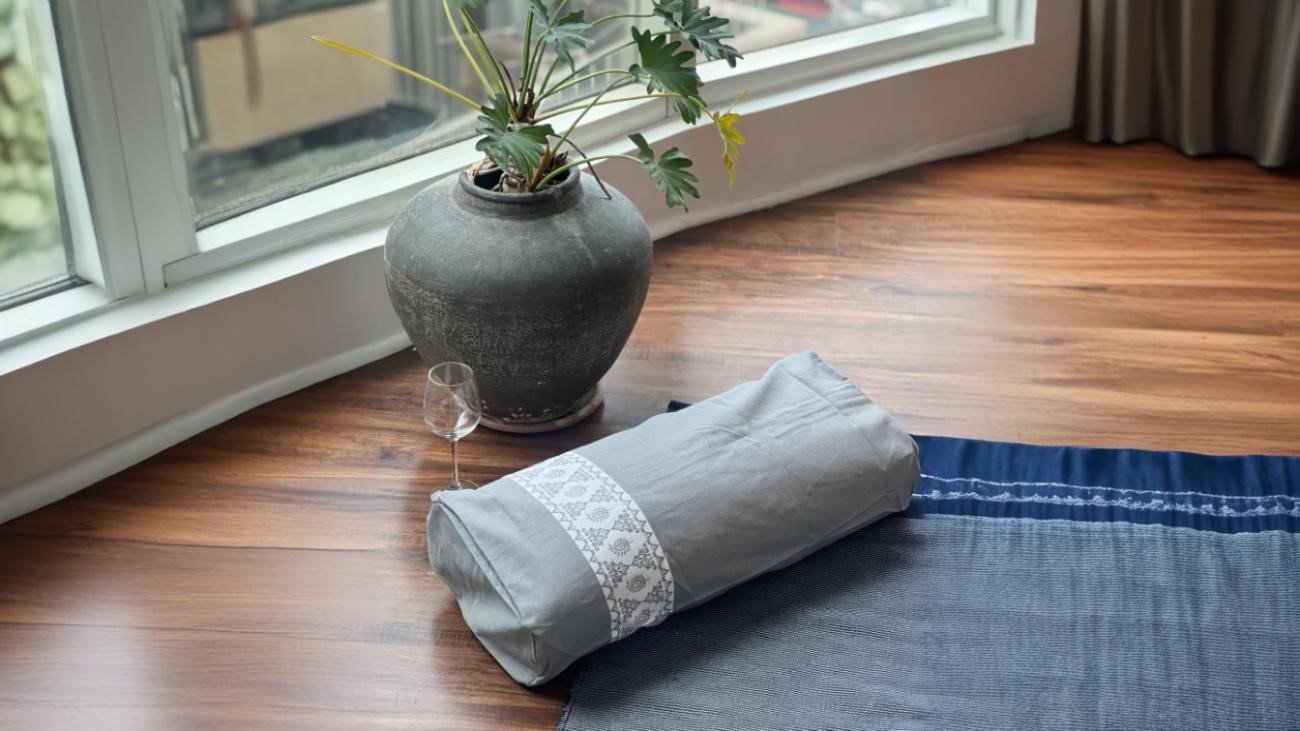
I had long regarded bolsters as expensive cushions until a back injury completely altered my perspective. That is when I realized that the positions we practice are equally as important as the props we select. Organic Cotton Yoga Bolsters and synthetic foam differ in ways that go beyond marketing.
Contents
What Makes Organic Cotton Yoga Bolsters Worth the Investment
Here’s what nobody tells you about cheap foam bolsters. They feel great for about three months. Then they start losing their shape. Lumps appear in strange places due to uneven filler compaction. When you try to puff up a bolster designed to support your spine in a restorative backbend, it feels more like a deflated beach toy.
Organic cotton filling doesn’t do that. Natural fibers maintain their density over time because cotton has an inherent springiness that foam just can’t replicate. When you’re holding a supported fish pose for five minutes, you need that consistent firmness. Your thoracic spine isn’t going to thank you if your bolster suddenly gives out halfway through.
Most body types can benefit from the standard size of 25 by 10.5 by 6.5 inches, which is useful for everything from supporting the hips in child’s pose to propping the knees in savasana.
What you actually get with quality organic cotton yoga bolsters:
- 100% organic cotton filling that maintains shape over the years
- Removable, machine-washable outer cover for easy cleaning
- An additional stylish cover is included for variety
- Durable cotton canvas construction
- Convenient carry bag for transport and storage
- Dimensions: 25″ L x 10.5″ W x 6.5″ H
Plus, they breathe naturally. Synthetic foam traps moisture and develops that gym smell nobody wants. These practical features matter during regular use.
Your Mat Choice Matters Just as Much
Cheap PVC mats might seem like good deals until you’re holding downward dog and your hands slowly slide forward. Yoga mats, which are environmentally friendly in their construction, have improved dramatically.
Here’s what makes the 4mm eco-friendly mat stand out:
- Natural tree rubber base with eco-polyurethane top layer
- EcoLock Surface Technology for superior grip
- 4mm thickness, balancing cushioning with stability
- Built-in alignment lines for proper positioning
- Non-slip performance even during heated practice
- Lightweight design (easy to carry)
- Closed-cell surface that resists moisture absorption
- Free from PVC, heavy metals, and latex
- Includes a convenient carrying strap
The thickness hits the sweet spot, thin enough for grounded balance poses, thick enough to protect knees in lunges. For those practicing at multiple locations, lightweight construction matters.
Good Props Actually Change Your Practice
Once I got serious about using quality props, my home practice became less of a chore. There’s something about knowing your natural cotton yoga bolsters and a solid mat are waiting for you that lowers the mental barrier to rolling out and actually doing the work.
Restorative yoga went from boring to genuinely therapeutic. Supported bridge pose with the bolster lengthwise under your spine? That releases tension in ways that active stretching just doesn’t touch. Using the bolster between your thighs in a reclined twist lets your hips fully relax instead of fighting to keep your knees together.
The maintenance factor is real, too. You will not need to perform weekly deep cleans because high-quality, eco-friendly yoga mats do not retain moisture. After practice, a little wipe-down is sufficient. Without the need for those sticky yoga blankets, the natural rubber bottom clingsto hardwood, tile, carpet, and pretty much any surface you would practice on.
And here’s the part that took me a while to appreciate: durability. That initial investment in good equipment pays off when your bolster still has its shape three years later, and your mat isn’t shedding microplastics all over your practice space. Cheap props end up in landfills. Quality ones become part of your practice for years.
Making the Switch to Better Equipment
Look, I get it. Spending real money on yoga props feels excessive when you can grab cheaper versions at any store. But there’s a difference between expensive and valuable. Natural cotton yoga bolsters fall into the valuable category because they actually enhance your practice rather than just taking up space in your closet.
The same goes for choosing yoga mats environmentally friendly in materials and construction. You’re not just buying a surface to practice on. You’re investing in equipment that supports your body properly, lasts through regular use, and doesn’t contribute to the massive problem of synthetic fitness gear waste.
Equipment for your practice should reflect your dedication to it. There is a perceptible difference when you step onto a sturdy, sticky mat and reach for a bolster that supports your body as it should. Not in some ethereal spiritual sense, but rather in tangible comfort and improved alignment.
Take Your Practice to the Next Level
If you’re ready to upgrade from props that barely do their job to equipment that genuinely supports your practice, check out what Gayo has put together. Their organic cotton bolsters come with washable covers and carrying bags, and the eco-friendly mats offer that grip-and-cushion balance that’s hard to find.
Visit Gayo shop and see the difference quality makes. Your body will notice, and your practice will thank you for it.