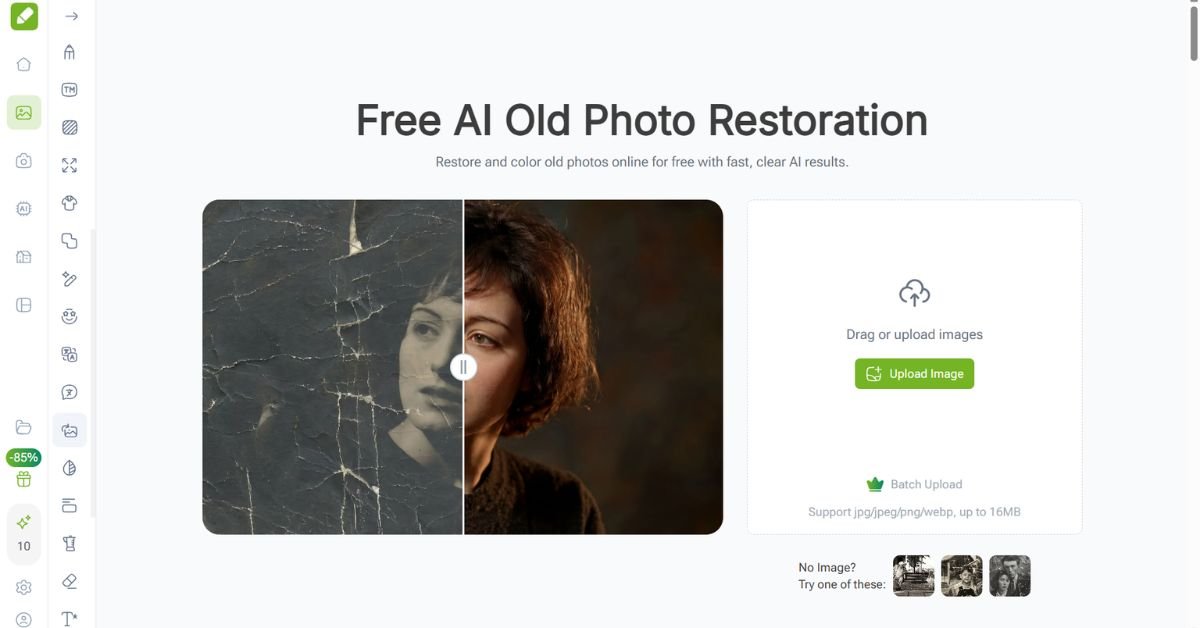
VisualGPT AI Old Photo Restoration and ImageEditor are increasingly used in situations where there is no second chance. Old photographs often exist as single copies. Once damaged, lost, or improperly processed, the information they carry cannot be recreated. This reality makes restoration fundamentally different from ordinary image enhancement.
This article approaches AI Old Photo Restoration not as a technical feature, but as a decision-making process: how much can be repaired, what should be preserved, and how AI can intervene without rewriting history.
Contents
- 1 The Real Problem with Old Photos Is Not Damage, but Uncertainty
- 2 Why VisualGPT AI Old Photo Restoration Prioritizes Structural Integrity
- 3 Restoration Is About Making Images Readable Again
- 4 The Moment Restoration Ends and Practical Use Begins
- 5 Why Separating Restoration and Refinement Matters
- 6 VisualGPT AI Old Photo Restoration as a Long-Term Preservation Tool
- 7 Conclusion: Restoration Requires Restraint, Not Aggression
The Real Problem with Old Photos Is Not Damage, but Uncertainty
Most people hesitate before restoring old photos, not because the damage is severe, but because the outcome is unpredictable. There is a legitimate fear that restoration may alter expressions, erase texture, or impose modern visual assumptions on historical material.
VisualGPT AI Old Photo Restoration is designed to reduce this uncertainty.
Instead of treating the photo as a surface to be cleaned, the system analyzes it as a visual record. Faces, clothing, background, and tonal transitions are evaluated independently. This allows the AI to distinguish between damage caused by time and details that define the photograph’s identity.
The restoration process becomes corrective rather than interpretive.
Why VisualGPT AI Old Photo Restoration Prioritizes Structural Integrity
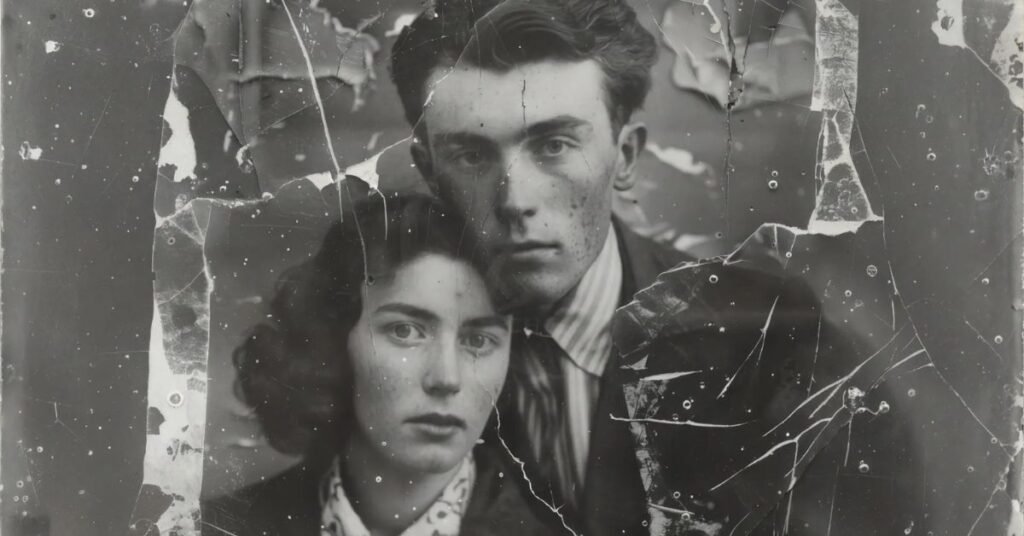
A key difference between restoring an old photo and editing a modern image lies in intent. Modern images are optimized for aesthetics. Old photos are optimized for meaning.
VisualGPT AI Old Photo Restoration focuses on structural integrity: edges that define form, contrast that reveals depth, and texture that conveys material and age. By restoring these elements conservatively, the AI avoids introducing visual elements that did not originally exist.
This approach is especially important for facial features. Subtle changes to eyes, mouth shape, or posture can significantly alter how a person is perceived. VisualGPT’s AI reconstruction logic is intentionally restrained, aiming to recover clarity without introducing expressive distortion.
Restoration Is About Making Images Readable Again
Many restored photos are never framed or displayed. Their value lies in interpretation rather than presentation. Families want to recognize relatives. Researchers want to study environments. Publishers want to contextualize historical narratives.
VisualGPT AI Old Photo Restoration restores readability.
Blurred outlines become recognizable figures. Washed-out text becomes legible. Foreground and background regain separation. These changes do not beautify the image; they restore access to information that was already there but no longer visible.
This distinction is critical. Restoration should not compete with the original photograph; it should step out of the way.
The Moment Restoration Ends and Practical Use Begins
After restoration, a subtle shift happens. The photo is no longer fragile or uncertain. It becomes usable. At this stage, different needs emerge, and this is where ImageEditor fits naturally into the workflow.
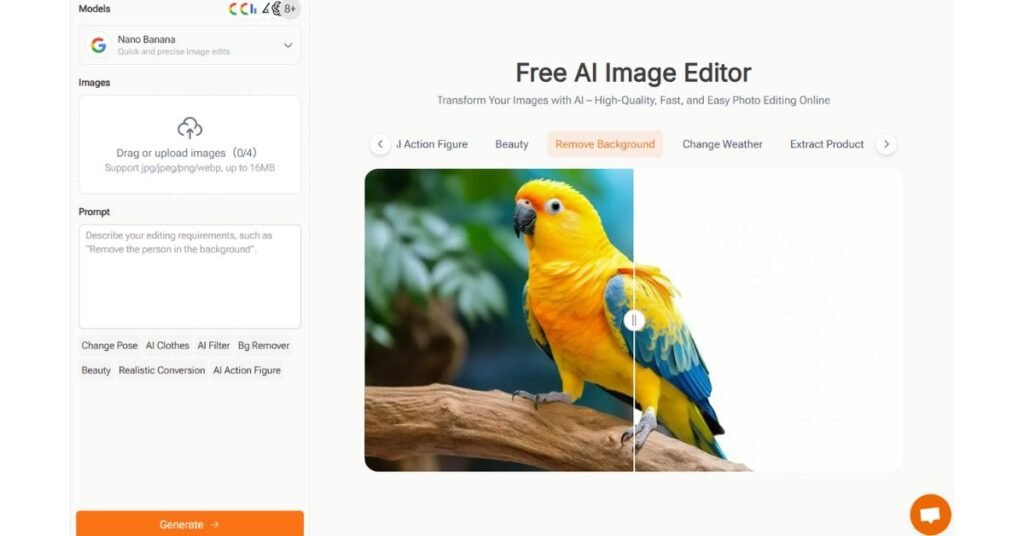
Restored photos often reveal secondary issues: uneven borders from scanning, legacy watermarks, or background distractions that were previously hidden by damage. ImageEditor addresses these concerns through AI-based refinement without interfering with the restored structure.
Importantly, ImageEditor is not used to “improve” the photo, but to adapt it for modern formats—cropping for digital archives, cleaning backgrounds for publication, or standardizing presentation across a collection.
Why Separating Restoration and Refinement Matters
Trying to solve everything in one step usually leads to compromise. VisualGPT AI Old Photo Restoration and ImageEditor work best when their roles are clearly separated.
VisualGPT handles historical repair. ImageEditor handles contemporary usability.
This separation ensures that restoration decisions remain conservative and respectful, while refinement decisions remain practical and reversible. The photo’s historical character is protected, even as its usability increases.
VisualGPT AI Old Photo Restoration as a Long-Term Preservation Tool
The true value of restoring old photos lies in durability. Digital archives evolve. Display standards change. What remains constant is the need for accurate source material.
VisualGPT AI Old Photo Restoration creates a stable foundation. Once restored, images can be stored, backed up, and reused without repeatedly revisiting the restoration step. ImageEditor can then be applied whenever the image needs to be adapted to a new context.
This layered approach supports long-term preservation without locking images into a single format or use case.
Conclusion: Restoration Requires Restraint, Not Aggression
VisualGPT AI Old Photo Restoration (https://visualgpt.io/ai-old-photo-restoration) succeeds because it understands what should not be changed. By focusing on structural recovery and historical fidelity, it allows old photographs to regain clarity without losing identity.
ImageEditor (https://imageeditor.online/) complements this process by solving practical problems that arise after restoration, ensuring restored photos can live comfortably in modern digital environments.
Together, they provide a balanced, realistic approach to AI Old Photo Restoration—one that values authenticity as much as usability.